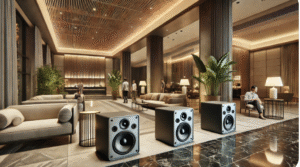
Great hotels don’t just look beautiful—they sound beautiful. From the moment a guest walks into your lobby to the last minute in the room before checkout, audio shapes emotion, nudges behavior, and elevates your brand. That’s why more forward-thinking properties are upgrading to modern box speakers across lobbies, restaurants, meeting rooms, pool decks, and suites. Done right, a well-planned box speaker strategy delivers measurable ROI: higher guest satisfaction, longer dwell time at F&B outlets, smoother events, and a premium, “I want to come back here” feeling.
Below, we’ll explore how box speakers can transform the guest journey, what to look for when choosing them, where to place them for maximum impact, and how smart audio integrates with the technology stack hotels are already deploying.
The Business Case for Better Sound
Hotels invest heavily in sightlines—lighting, finishes, art—but sound is half the experience. When audio is muddy, thin, or inconsistent, guests subconsciously downgrade their perception of quality. Conversely, consistent, full-bodied sound makes spaces feel polished, intentional, and premium. Industry commentary increasingly ties improved in-room and on-property tech to stronger satisfaction and loyalty outcomes, from entertainment and controls to communications—areas where quality speakers make a tangible difference. See coverage on hotel tech elevating guest experience at HOTELS Magazine. HOTELSMag.com
Box speakers—compact, purpose-built enclosures—offer a sweet spot for hotels: they’re aesthetically flexible, easy to mount or place, scalable for small areas or large zones, and capable of delivering warm, intelligible sound at conversational volumes. That means a lobby that feels lively but not loud, restaurants where table talk stays clear, and guestrooms where music and TV audio feel immersive without disturbing neighbors.
What Guests Want Now (and How Sound Helps)
Guest expectations have climbed, driven by consumer tech at home and hotels’ own innovation cycles. Surveys and trend reports consistently show a push toward personalization, comfort, and seamless tech that “just works,” especially in the room and at entertainment touchpoints. Publications covering hotel tech trends for 2025 underscore this movement toward integrated, guest-friendly solutions that enhance ambience and ease of use, not complexity. See trend roundups at Hospitality Net and insight pieces on personalization from EHL’s Hospitality Insights at EHL Hospitality Insights. Hospitality Net+1
Crucially, as properties add more technology, they must avoid overwhelming guests. A recent pulse from Hotel Management points out that hotels feel pressure to keep upgrading—but guests can struggle if tech isn’t intuitive. Well-tuned audio, however, is a “quiet” upgrade: it enhances perceived quality without adding friction to the stay. See the latest survey coverage at Hotel Management. Hotel Management
Why Box Speakers Beat Built-In TV Audio (and Many Soundbars) 📺
Most TVs ship with down-firing or rear-firing speakers that sacrifice clarity for thinness. In real rooms—where soft furnishings and room geometry affect acoustics—dialogue can sound hollow, bass can vanish, and guests crank volume to compensate. Box speakers solve for this by:
-
Projecting sound forward for cleaner dialogue at lower volumes
-
Offering wider frequency response for music that actually feels musical
-
Providing more consistent coverage so one corner of the room isn’t “dead air” and another isn’t too loud
-
Scaling up with a second speaker for true stereo separation in suites
The net effect is a quieter property overall (because guests don’t need to blast audio) and happier neighbors. That’s a win for sleep scores, an amenity that travelers increasingly prioritize. See coverage on evolving in-room entertainment expectations at Hotelier Magazine. Hotelier Magazine
Elevating Every Zone: Where Box Speakers Shine
Lobby and Reception
Your lobby is your acoustic handshake. Curated playlists at tasteful volumes make arrivals feel calm and intentional. Compact box speakers can be ceiling-mounted, wall-mounted, or placed discreetly on shelving to preserve sightlines. In open atriums, distributed placement avoids “hot spots,” keeping sound even across check-in lines, lounge seating, and bar areas.
Restaurants, Bars, and Cafés ☕
Good audio makes people linger. Box speakers with wide dispersion help maintain intelligibility at conversation levels, reducing the “shout to be heard” problem. Tie them into dayparting: brighter, lighter sound at breakfast; deeper, more relaxed vibes at dinner; upbeat sets for weekend brunch. The right soundtrack at the right volume encourages another round or dessert—small shifts that compound F&B revenue.
Meeting Rooms and Event Spaces
For corporate meetings and social events, intelligibility is king. Box speakers designed for speech clarity keep presentations crisp without fatiguing the audience. For flexible ballrooms, a modular, zoned design allows you to scale coverage based on room partitions. As hotels continue to evolve event tech, future-ready entertainment stacks—AV included—are front and center. See in-room and venue trends covered by Hotel Management. Hotel Management
Pool, Spa, and Wellness Areas 🧘
Weather-resistant box speakers bring consistent sound outdoors and into humid zones. At pools, subtle audio helps define the brand while respecting neighboring rooms. In spas, mellow, full-range sound supports relaxation rituals. As wellness becomes a bigger travel driver, sensory consistency—sound included—reinforces your positioning.
Premium and Suite Categories
Upgrading suites with a pair of compact speakers can be an upsell differentiator. Guests notice the “cinema at sane volume” effect and rate their rooms higher. For extended-stay and bleisure travelers, better audio supports music listening, fitness apps, and higher-quality video calls.
Integrations: Make Audio Part of a Cohesive Tech Story 🔌
Modern hotel stacks emphasize personalization, automation, and staff efficiency. Box speakers fit cleanly into that narrative:
-
Zone control and scheduling: Tie speakers into a central DSP or software-defined audio matrix to automate dayparting and volumes by zone.
-
Voice and in-room control layers: As properties experiment with voice assistants and app-based controls, audio becomes a natural extension of the experience—without requiring guests to learn “one more thing.” Industry commentary has explored how voice and AI-driven personalization can boost comfort when used thoughtfully. See coverage at Hotel Management and Skift’s discussion of AI’s role in hospitality at Skift. Hotel Management+1
-
Events and hybrid meetings: Box speakers can double as program audio for smaller events, reducing rental friction and setup time.
-
Brand standards enforcement: Centralized preset libraries ensure every property—new build or conversion—hits the same sonic signature.
Acoustic Design 101 for Hoteliers
You don’t need a recording studio—just a plan. A qualified integrator will map zones, calculate coverage, and recommend a mix of loudspeaker sizes to achieve even SPL (sound pressure level) throughout. Key concepts:
-
Distributed vs. point-source: Many small box speakers around a room typically yield better consistency than one large, loud source.
-
Mounting height and angle: Aim toward ear height in seated areas; avoid hard, reflective surfaces whenever possible.
-
DSP and limiting: A digital signal processor can apply gentle EQ, compression, and brick-wall limiting to protect guest comfort and your hardware.
-
Source quality: Compressed streams sound worse at scale. Opt for licensed, high-quality streams or locally hosted playlists.
As hotel technology trends spotlight hardware that quietly enhances the stay, audio stands out as a low-friction, high-impact upgrade. See 2025 tech trend coverage at Hospitality Net. Hospitality Net
Selecting the Right Box Speakers
When evaluating models, weigh the following:
-
Frequency response and clarity: Look for honest specs and, ideally, a demo in a space similar to yours.
-
Dispersion pattern: Wider, controlled dispersion means fewer units to cover a space evenly.
-
Aesthetics and footprint: Neutral finishes, grille options, and cable-management features help speakers disappear into your design.
-
Power and amplification: Active (self-powered) units simplify installs in some areas; passive systems with centralized amplification suit larger zones.
-
Weather resistance: For pools, terraces, and entrances, seek IP-rated enclosures and corrosion-resistant hardware.
-
Serviceability: Front-grille access for quick swaps, standardized mounts, and strong vendor support reduce downtime.
Training Your Team for Consistency
Great gear still needs great habits. Train F&B, front-desk, and events staff on:
-
Appropriate target volumes by zone and daypart (breakfast vs. dinner, lobby afternoon vs. late night)
-
Playlist curation aligned to brand voice (no explicit lyrics; tempo matches the crowd)
-
Fast troubleshooting (source checks, cable integrity, verifying network or amplifier status)
-
Escalation protocol (when to call engineering or your integrator)
When staff can own the sonic environment, the brand feels intentional hour by hour—without engineering babysitting the system.
Measuring ROI: Beyond “It Sounds Nice” 📈
Tie audio to real metrics:
-
F&B dwell time and check averages: Compare like-for-like periods pre- and post-installation.
-
Guest satisfaction indices: Track review mentions of “vibe,” “atmosphere,” “music,” “noise,” and “sleep.”
-
Event revenue and repeat bookings: Better speech intelligibility and background music can improve event ratings and referrals.
-
Complaint reduction: Fewer noise complaints when guests don’t need to raise TV volume.
Industry observers continue to stress that tech investments should prioritize guest ease and perceived quality. Balanced, guest-friendly upgrades win—flashy but fussy ones don’t. See broader guest-experience tech context at Skift and Hospitality Net. Skift+1
Future-Proofing Your Audio Strategy
The hospitality tech landscape moves fast, but sound fundamentals last. Look for systems that are:
-
Scalable: Add zones or swap speakers as spaces evolve.
-
Standards-based: Use familiar connectors and protocols so you’re not locked into a single vendor.
-
Network-ready: IP-addressable amplifiers and DSPs allow remote monitoring, scene recalls, and rapid diagnostics.
-
Secure and compliant: Coordinate with IT to keep control systems on secure VLANs with proper credentials and updates.
-
Content-flexible: From licensed streaming to curated local libraries, ensure your legal bases are covered and your brand sound remains consistent.
Practical Rollout Plan (Without Disrupting Operations)
-
Discovery: Walk the property and list zones, moods, hours, and acoustic challenges.
-
Pilot: Choose one flagship area (e.g., lobby bar) and measure results—guest comments, dwell time, and check averages.
-
Standardize: Document target SPLs, playlists, and open/close procedures; push standards portfolio-wide.
-
Stage installs: Sequence by impact and ease—public spaces first, then high-revenue F&B, then suites.
-
Train and maintain: Build short SOPs and assign ownership to on-site champions.
The Competitive Edge: Sound as a Signature ✨
Travelers increasingly choose hotels that feel intentional: clear design language, confident service, and experiences that engage all senses. Publications tracking luxury and lifestyle segments have highlighted sound as a new frontier of brand differentiation—done tastefully, it signals quality without shouting. See this perspective at Skift. Skift
When your property sounds as good as it looks, guests notice. And they tell their friends.
Conclusion: Make Every Stay Sound Remarkable 🎯
Box speakers are a small physical investment with an outsized emotional return. They make your lobby feel welcoming, your restaurants more convivial, your meeting rooms clearer, your suites more premium, and your brand more memorable. In a market where guests crave comfort and effortless tech, great sound is a high-impact, low-friction upgrade that pays dividends in satisfaction, spend, and loyalty.
Treat audio like design: plan it, standardize it, and let it carry your brand from check-in to lights out. Your guests—and your bottom line—will hear the difference. For more context on how hotels are refining experience with tech in 2025, see coverage at Hospitality Net, Hotel Management, HOTELS Magazine, and Skift. Skift+3Hospitality Net+3Hotel Management+3
Authority links (Hotel News):
-
Hospitality Net – 2025 hospitality technology trends. Hospitality Net
-
Hotel Management – Survey on guest-facing tech pressure and usability. Hotel Management
-
HOTELS Magazine – Tech elevating guest experience. HOTELSMag.com
-
Skift – The importance of sound in modern hospitality. Skift