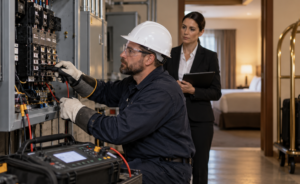
Hotels depend on electricity every hour of every day. Guest rooms, commercial kitchens, laundry facilities, elevators, heating and cooling systems, lighting, conference spaces, security equipment, computers, pool systems, vending areas, and maintenance departments all rely on electrical components functioning safely and consistently. In Lawton, Oklahoma, where hotels serve leisure travelers, business visitors, military families, contractors, and people traveling through Southwest Oklahoma, dependable electrical systems are a basic part of keeping a property operating smoothly.
That reality is placing greater attention on preventive electrical maintenance, including dielectric testing. Rather than waiting for a piece of electrical equipment to visibly fail, testing can help identify weaknesses in insulation and electrical protective equipment before those weaknesses contribute to a larger problem.
For Oklahoma hotel operators, electrical safety is not simply a maintenance issue. It touches employee safety, guest confidence, equipment reliability, business continuity, and the long-term condition of the property.
Electrical Safety Has a Direct Impact on Hotel Operations
A hotel functions more like a small commercial campus than a typical residential building. Even a modest property can contain hundreds of electrical devices operating simultaneously. Larger hotels add commercial kitchens, meeting rooms, fitness centers, swimming pools, elevators, laundry equipment, extensive HVAC systems, emergency lighting, and computerized building controls.
The U.S. Department of Energy recognizes hotels as part of the commercial building sector, where facilities often have significant energy requirements and complex building systems. DOE commercial reference building resources specifically include both small and large hotels among the building types used for energy and building-performance analysis.
That complexity makes ongoing maintenance particularly important.
Electrical equipment can continue operating even while insulation begins deteriorating. Heat, age, vibration, moisture, contamination, repeated use, accidental damage, and environmental conditions can gradually affect insulating materials. The equipment may appear normal until deterioration reaches a point where electrical current travels somewhere it should not.
The goal of preventive testing is to find potential weaknesses before failure becomes the first indication that something is wrong.
What Dielectric Testing Actually Evaluates
Dielectric testing evaluates the ability of an insulating material or electrical component to withstand electrical voltage without breaking down.
According to Wikipedia’s overview of dielectric withstand testing, the process is commonly used to determine whether electrical insulation can function safely under specified conditions. The test may involve applying voltage between insulated sections of equipment or between energized components and ground while monitoring whether unacceptable current leakage occurs.
The principle is straightforward. Electrical insulation exists to prevent current from traveling into places where it could create a shock, equipment failure, or other hazard. Testing provides measurable information about whether that insulation is still performing as intended.
Different equipment requires different procedures, test voltages, standards, and evaluation criteria. Dielectric testing is therefore not a universal test performed identically on every electrical component. Appropriate procedures depend on the equipment being inspected and the applicable safety requirements.
Hotels and other commercial properties may use testing as one element of a broader preventive electrical maintenance program.
Why Lawton Hotels Have So Many Electrical Systems to Maintain
Hotel guests may notice outlets, lamps, televisions, air conditioning units, elevators, and hallway lighting, but much of a hotel’s electrical infrastructure operates out of public view.
Behind the scenes are electrical panels, distribution equipment, commercial appliances, pumps, motors, maintenance tools, HVAC components, laundry machines, kitchen equipment, emergency systems, computers, networking equipment, building controls, and countless electrical connections.
The U.S. Department of Energy’s Building Technologies resources describe modern commercial buildings as environments containing numerous interconnected systems, including HVAC, hot-water equipment, lighting, appliances, and control systems.
For hotels, this concentration of equipment means electrical reliability can influence nearly every department.
A single problem may affect much more than one device. Depending on where a failure occurs, it could interrupt guest-room service, climate control, kitchen operations, laundry production, elevators, building access systems, or other essential functions.
Preventive electrical maintenance gives hotel operators an opportunity to address conditions on a planned schedule instead of dealing exclusively with emergency repairs.
Employee Safety Remains a Major Consideration
Hotel employees routinely work around electrically powered equipment. Housekeeping teams use vacuums and cleaning equipment. Kitchen employees work around powered appliances and water. Maintenance workers interact with electrical systems, motors, tools, HVAC units, pumps, and building equipment. Laundry employees operate commercial washers, dryers, and related machinery.
These working environments make electrical safety procedures especially important.
The Occupational Safety and Health Administration identifies electrical hazards associated with faulty equipment, wiring, damaged electrical components, and equipment used near water. OSHA guidance also emphasizes keeping electrical equipment free from recognized hazards and removing defective or damaged portable electrical equipment from service until appropriate repairs and testing have been completed.
Although OSHA guidance is based on specific workplace circumstances and standards, the underlying lesson applies broadly to commercial facilities. Electrical equipment should be inspected, maintained, and handled according to appropriate safety practices.
Preventive testing can support that larger safety program by providing information that ordinary visual inspection may not reveal.
Electrical Insulation Can Deteriorate Without Obvious Warning Signs
One challenge with electrical equipment is that deterioration is not always visible.
A damaged plug, burned receptacle, frayed cord, or overheated component provides an obvious warning. Insulation deterioration inside equipment may not.
Electrical insulation can be affected gradually by temperature changes, contaminants, mechanical stress, aging, moisture, vibration, improper storage, repeated operation, or physical damage. Depending on the equipment, these conditions can reduce the insulating material’s ability to withstand electrical stress.
The U.S. Consumer Product Safety Commission maintains electrical safety information addressing hazards associated with consumer electrical products, cords, power equipment, and other electrically powered devices.
Commercial properties generally contain even more electrical equipment than the average residence, increasing the importance of organized inspection and maintenance procedures.
Dielectric testing provides hotel maintenance departments and electrical professionals with another method of evaluating components that may otherwise appear serviceable.
Preventive Testing Can Reduce Unexpected Operational Disruptions
Unexpected equipment failure is especially disruptive in the hospitality industry because hotels operate continuously.
A manufacturing business may be able to schedule production downtime. A retail location may close overnight. A hotel still has occupied rooms, refrigeration equipment, security systems, climate-control requirements, elevators, emergency systems, and employees working throughout the property.
Electrical interruptions can therefore create immediate operational consequences.
An air-conditioning problem during an Oklahoma summer can quickly generate guest complaints. Laundry equipment failure can delay room turnover. Kitchen equipment failure can disrupt food service. An electrical problem affecting elevators can interfere with accessibility and guest movement.
Preventive maintenance cannot eliminate every possibility of equipment failure, but it can improve the chances of identifying developing problems before they become emergencies.
The Department of Energy’s information on building electrical appliances, devices, and systems demonstrates how diverse electrical loads have become within modern buildings, encompassing appliances, plug loads, controls, sensors, infrastructure, and numerous other electrical devices.
The more dependent a hotel becomes on electrical technology, the more valuable organized electrical maintenance becomes.
Dielectric Testing Fits Into a Larger Electrical Safety Program
Dielectric testing should not be treated as a replacement for routine inspections, proper grounding, equipment maintenance, employee training, qualified electrical work, or other established safety procedures.
It is one tool within a broader electrical safety strategy.
OSHA’s electrical safety requirements emphasize safe work practices around equipment and circuits that are or may be energized. The agency’s regulations include procedures for deenergizing equipment, verifying electrical conditions, and using appropriate test equipment when required.
Hotels can support electrical safety through a combination of visual inspections, equipment maintenance, prompt repair of damaged electrical components, appropriate documentation, employee reporting procedures, professional electrical evaluations, and specialized testing where appropriate.
That approach creates several opportunities to identify a problem instead of relying on a single safeguard.
Certain Protective Equipment Requires Periodic Electrical Testing
Electrical testing is also important for protective equipment used by employees who work around electrical hazards.
OSHA regulations covering electrical protective equipment specify periodic electrical testing for certain insulating equipment and state that the testing method must reliably determine whether the insulating equipment can withstand the voltages involved.
This distinction matters because dielectric testing can involve several different types of electrical assets and protective equipment.
Hotel operators should therefore rely on qualified professionals to determine which equipment should be tested, which standards apply, how frequently testing should occur, and what test procedures are appropriate.
There is no benefit in performing the wrong test simply because a facility wants to say that testing was completed.
The value comes from using the correct procedure for the correct equipment.
Lawton’s Hospitality Industry Depends on Reliable Commercial Facilities
Lawton occupies an important position in Southwest Oklahoma. The city serves visitors traveling for business, tourism, government activities, regional events, family visits, and connections to Fort Sill.
That makes hotels an important part of the local commercial infrastructure.
Information available through Oklahoma’s official tourism website, TravelOK, illustrates the state’s extensive hospitality and tourism economy, covering accommodations, attractions, destinations, events, and travel throughout Oklahoma.
Properties competing for travelers must pay attention to far more than room appearance. Guests expect air conditioning to work, elevators to operate, lighting to function, outlets to be usable, electronic locks to respond, televisions and internet equipment to work properly, and common areas to remain comfortable.
Many of those expectations ultimately depend on reliable electrical infrastructure.
Professional Testing Can Strengthen a Hotel’s Maintenance Records
Documentation is another advantage of formal testing programs.
Hotel maintenance teams routinely maintain records for HVAC service, elevators, fire protection equipment, pools, commercial kitchen systems, pest control, and other building operations. Electrical testing records can become part of that same maintenance history.
For local properties evaluating electrical safety services, professional Dielectric Testing Lawton can provide another component of a structured electrical maintenance strategy.
Testing documentation can help establish when equipment was evaluated, what procedures were performed, what condition was identified, and whether follow-up attention was recommended.
Those records can also help maintenance departments monitor equipment over time instead of treating each service visit as an isolated event.
Hotel Renovations Create Another Opportunity for Electrical Evaluation
Hotels are frequently remodeled in phases. Guest rooms may receive new lighting, televisions, refrigerators, microwaves, charging ports, HVAC equipment, furniture with built-in electrical connections, and electronic controls. Common areas may gain digital displays, automated doors, new food-service equipment, upgraded conference technology, or modern building controls.
Every renovation can alter the electrical demands placed on the property.
The U.S. Department of Energy emphasizes the importance of considering energy performance, electrical technologies, codes, standards, and commissioning throughout commercial building design and construction.
Hotel owners planning renovations can use those projects as an opportunity to evaluate existing electrical equipment and determine whether additional inspection, maintenance, testing, or upgrades should be included.
Older infrastructure and newer electrical technology frequently coexist in hospitality properties. That makes professional evaluation particularly valuable when significant renovations take place.
Electrical Reliability Supports the Guest Experience
Most hotel guests will never know whether electrical testing has occurred, and that is usually the point.
Successful facility maintenance often remains invisible.
Guests remember the room that became hot because the air conditioner stopped working. They remember the elevator that was unavailable, the outlet that did not work, or the power interruption that disrupted their stay.
They rarely notice the preventive maintenance that helped those problems never occur.
That is why electrical reliability belongs within the larger conversation about hospitality quality. Clean rooms, courteous staff, comfortable beds, and attractive common areas remain important, but the systems behind the walls make those experiences possible.
Electrical safety and maintenance support the entire operation.
Conclusion
Lawton hotels operate in an increasingly technology-dependent environment where electrical equipment supports nearly every aspect of the guest experience. Rooms, kitchens, laundry facilities, HVAC systems, elevators, building controls, security equipment, pools, conference areas, and administrative offices all depend on reliable electrical systems.
Dielectric testing provides one way to evaluate whether electrical insulation and certain protective components continue to withstand the electrical conditions for which they are intended. When incorporated into a broader preventive maintenance program, testing can help qualified professionals identify potential weaknesses, document equipment condition, and recommend corrective action before a hidden problem develops into a larger disruption.
For Oklahoma’s hospitality industry, electrical safety deserves the same deliberate attention given to other critical building systems. Hotels are around-the-clock businesses, and their electrical infrastructure works around the clock with them.
As Lawton’s lodging properties maintain, renovate, and modernize their facilities, preventive electrical testing is becoming an increasingly relevant part of responsible hotel operations. The work happens mostly behind the scenes, but its purpose is visible every day through safer workplaces, dependable equipment, uninterrupted operations, and a more reliable experience for everyone who walks through the door.