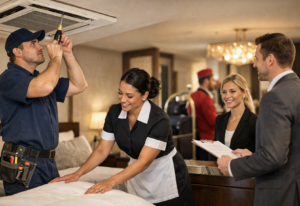
In hospitality, the guest sees the smile at the front desk, the spotless room, the smooth check-in, and the calm confidence of a property that feels well run. What guests do not see is the discipline underneath it all. That is where Fixed Operations matters. In a hotel setting, fixed operations can be understood as the behind-the-scenes systems that keep maintenance, service standards, staffing coordination, asset care, cleanliness, and daily execution moving in sync. In a business built on consistency, those internal systems shape the guest experience long before a review is written or a return stay is booked.
Hotels operate within the broader hospitality industry, where service, lodging, operations, and reputation all intersect. That matters even more in today’s environment because hotel leaders are facing a mix of steady travel demand, labor pressure, rising insurance and energy costs, and a marketplace where modest revenue growth can be swallowed quickly by operating expenses. Recent reporting from the American Hotel & Lodging Association, Deloitte’s 2025 travel industry outlook, and CBRE’s U.S. Hotels State of the Union all point in the same direction. Demand remains meaningful, but margins are under pressure, which puts more weight on the quality of daily execution.
Cost Pressure Makes Operational Discipline Non-Negotiable
A hotel does not lose money only through major failures. It loses money in small, repeated misses. Deferred maintenance turns into bigger repairs. Slow room turns reduce availability. Poor communication between departments causes rework. Energy waste, supply overuse, missed preventative service, and weak scheduling quietly chip away at profitability. When conditions are tight, hotels cannot afford loose operations because even a property with healthy demand can see margins shrink when expenses rise faster than performance. AHLA’s March 2026 survey found that hotel owners identified cost of goods and supplies, labor costs, fluctuating demand, utility and energy costs, and insurance premiums among their biggest financial pressures.
That is why hotel fixed operations matters more than ever. It gives leadership a framework for protecting profit through consistency. It supports routine inspections, better vendor coordination, clearer maintenance schedules, tighter housekeeping workflows, and stronger accountability across departments. CBRE has warned that soft top-line growth combined with elevated inflation is expected to keep pressure on hotel profits and margins through at least 2026. In that kind of climate, operational strength is no longer a support function. It is part of the revenue strategy.
Staffing Challenges Put More Weight on Systems
Labor strain changes how a hotel must operate. A fully staffed property can sometimes cover for a weak system because experience and extra hands smooth over mistakes. An understaffed property cannot. More than half of hotel owners surveyed by AHLA reported that their properties were somewhat or severely understaffed, and many are using higher wages, flexible scheduling, discounts, and benefits to recruit and retain workers. AHLA also reported in 2025 that hotel employment was expected to rise year over year, while national staffing levels still remained below 2019 levels.
That reality makes processes more valuable than ever. When staffing is tight, every department needs stronger handoffs, clearer priorities, easier training, and fewer avoidable errors. A well-run hotel cannot depend on heroic effort every day. It needs routines that make good work easier to repeat. Strong operations reduce confusion for housekeepers, maintenance teams, front desk staff, managers, and vendors. They shorten the learning curve for new employees and help experienced employees spend less time fixing preventable issues. In practical terms, that can mean standardized room readiness procedures, digital maintenance tracking, better shift communication, cleaner incident documentation, and clearer escalation paths for guest problems. Those are not glamorous details, but they are often the difference between a stressed team and a stable one.
Guest Expectations Keep Rising Even When Margins Tighten
Guests judge a hotel by outcomes, not internal excuses. They do not separate maintenance from hospitality, or staffing from service. They experience the whole property as one brand promise. A delayed check-in, an HVAC issue, a missed wake-up call, a poorly cleaned bathroom, or a slow response to a broken amenity all become part of the same impression. That is why operational consistency is inseparable from brand trust.
At the same time, demand patterns are still evolving. Deloitte reported that travel demand remained strong heading into 2025, shaped by post-pandemic prioritization of travel, remote-work flexibility, and continued willingness among many travelers to spend on trips. Hotel Dive also reported that CoStar and Tourism Economics projected ADR growth of 1% and RevPAR growth of 0.6% for 2026, while occupancy was expected to dip slightly to 62.1%, showing that growth is still possible but modest. In a market like that, hotels cannot rely only on rate increases or general demand. They have to protect the guest experience at the property level.
This is where fixed operations becomes a competitive advantage. It helps a hotel deliver the small proofs of quality that guests remember. Rooms are ready when promised. Elevators work. Hallways feel cared for. Public spaces stay clean throughout the day instead of only looking good during scheduled checks. Preventative maintenance reduces surprise outages. Guest complaints are documented, routed, and resolved instead of being forgotten between shifts. The stronger those systems become, the more trustworthy the brand feels to the traveler.
Technology Is Now Part of Daily Hotel Execution
Technology has moved from being a helpful extra to being part of modern hotel survival. That does not mean technology replaces hospitality. It means technology helps teams protect hospitality when labor is tight and expectations are high. Skift’s 2025 hospitality tech reporting emphasizes a shift toward digital transformation, AI-powered personalization, modular systems, and tools that improve both operations and guest experience. Hospitality Net also pointed to a 2025 environment where consumer demand stayed resilient while hoteliers faced more performance pressure and responded by automating and innovating.
For hotels, the lesson is practical. Strong operations today often involve better software visibility, quicker response loops, and cleaner operational data. Maintenance tickets should not disappear into a notebook. Housekeeping status should not depend on guesswork. Repeated guest complaints should not stay buried in separate systems. Leadership should be able to see patterns, not just individual incidents. When a hotel combines human service with better operational tools, it becomes easier to keep service standards high without placing unreasonable stress on the team.
That kind of technology use also strengthens long-term asset protection. Hotels are physical businesses with expensive rooms, shared spaces, mechanical systems, furniture, fixtures, and amenities that must hold up under daily wear. Better tracking, preventative planning, and disciplined follow-through help a property avoid the costly cycle of reacting late to issues that could have been addressed early. In a slower-growth environment, preserving the life of the asset becomes part of protecting the future of the business.
Strong Hotel Operations Protect Reputation and Revenue
Operational weakness does not stay hidden for long. In hospitality, it shows up in reviews, internal burnout, lower guest confidence, slower turns, repeat maintenance calls, and weaker brand perception. Over time, those issues can erode pricing power because travelers do not pay premium rates for properties that feel unreliable. Even when the location is strong, execution still matters. A hotel that feels inconsistent can lose repeat guests, group business, and referral momentum.
Strong fixed operations helps protect against that slide. It creates the structure that lets service teams succeed more often. It supports cleanliness, safety, maintenance readiness, communication, and consistency across shifts. It also gives ownership and management clearer visibility into what is happening inside the building. That visibility matters because problems are easier to solve when they are measured, documented, and reviewed instead of being passed around informally.
There is also a leadership benefit. Hotels that run well tend to create more confidence internally. Teams know what is expected. Managers have better information. Vendors are easier to hold accountable. New hires enter a clearer environment. Guests feel the difference, even if they never use the phrase fixed operations. They simply describe the hotel as smooth, dependable, clean, organized, and worth returning to. In a reputation-driven business, that kind of consistency is valuable.
Conclusion
Why hotel fixed operations matter more than ever comes down to one truth. Hotels are being asked to do more with less room for error. Costs remain elevated. Staffing pressure remains real. Guests still expect seamless experiences. Growth forecasts exist, but they are not so strong that a hotel can afford operational waste. The properties that perform best will not be the ones that only market well. They will be the ones that execute well every day.
A hotel’s success is built in the moments guests notice and in the systems they never see. When maintenance is proactive, teams communicate clearly, rooms turn efficiently, service feels dependable, and standards hold under pressure, the entire property becomes stronger. That is why fixed operations matters now more than ever. It protects the guest experience, the team experience, the asset, the reputation, and the bottom line all at once.